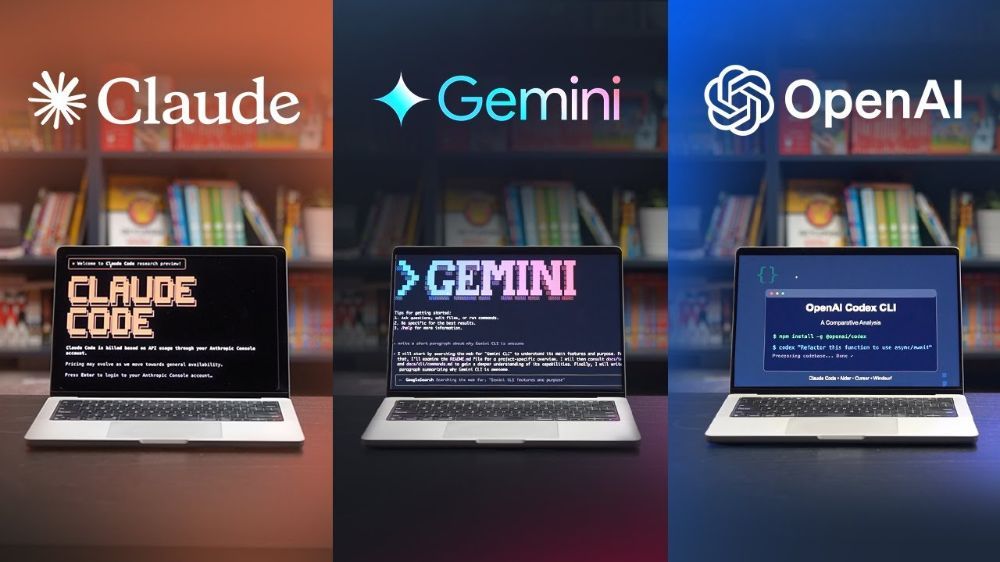
In 2026, AI coding tools have evolved far beyond autocomplete. Tools like OpenAI Codex CLI, Claude Code, and Gemini CLI are now full-fledged agentic developers that can read codebases, execute commands, fix bugs, and even ship features autonomously. But while they share similar goals, their philosophies and real-world performance differ significantly. Let's break down how they compare—and which one you should actually use.
The Rise of Terminal-Based AI Coding Agents
All three tools operate directly in the terminal, giving developers a powerful interface to interact with AI using natural language. Instead of switching between IDE plugins and chat windows, you can now instruct an AI to analyze your repository, refactor code, or run scripts—all from the command line.
This shift marks a fundamental change: AI is no longer just assisting developers—it's actively collaborating and sometimes even acting independently.
Core Differences in Design Philosophy
At first glance, these tools look similar. Under the hood, however, they are built with very different priorities:
- Claude Code focuses on deep reasoning and reliability. It excels at understanding large codebases and producing clean, production-ready code with fewer errors.
- Codex CLI emphasizes autonomy and execution. It can run commands, automate pull requests, and operate safely thanks to OS-level sandboxing.
- Gemini CLI prioritizes extensibility and scale, offering integrations, extensions, and an extremely large context window for handling massive projects.
In short, Claude acts like a senior engineer, Codex like a fast executor, and Gemini like a flexible platform.
Performance and Accuracy in Real Use
When it comes to actual coding performance, differences become more obvious.
- Claude Code consistently produces correct code on the first try, with reported success rates around 90%+ in practical testing.
- Codex CLI performs strongly in automation and structured tasks like PR generation and system-level scripting.
- Gemini CLI, while powerful in theory, sometimes struggles with consistency and may require more iterations to reach a working solution.
Interestingly, academic and benchmark-style evaluations show that no single tool dominates every task. For example, Codex performs consistently well across diverse coding tasks, while Claude excels in documentation and complex feature development.
Security, Cost, and Ecosystem
Beyond performance, practical considerations matter just as much.
- Security: Codex CLI stands out with OS-level sandboxing, reducing the risk of harmful code execution.
- Cost: Gemini CLI offers the most generous free tier, making it attractive for beginners or experimentation.
- Ecosystem: Claude integrates deeply with team workflows, while Gemini offers extensibility through plugins and integrations.
These differences often determine which tool fits into your workflow—not just raw performance.
Final Verdict: Which One Should You Choose?
There is no universal winner—but there is a clear pattern.
If you care about correctness, readability, and architectural thinking, Claude Code feels the most human and reliable. If your priority is automation, speed, and execution—especially in CI/CD pipelines—Codex CLI becomes a powerful ally. Meanwhile, Gemini CLI is best seen as an experimental and extensible platform, ideal for developers who want flexibility or a free entry point into AI coding.
Ultimately, the choice isn't about which tool is objectively better—it's about how you work. The best developers in 2026 are no longer choosing just one AI—they're orchestrating multiple agents together.